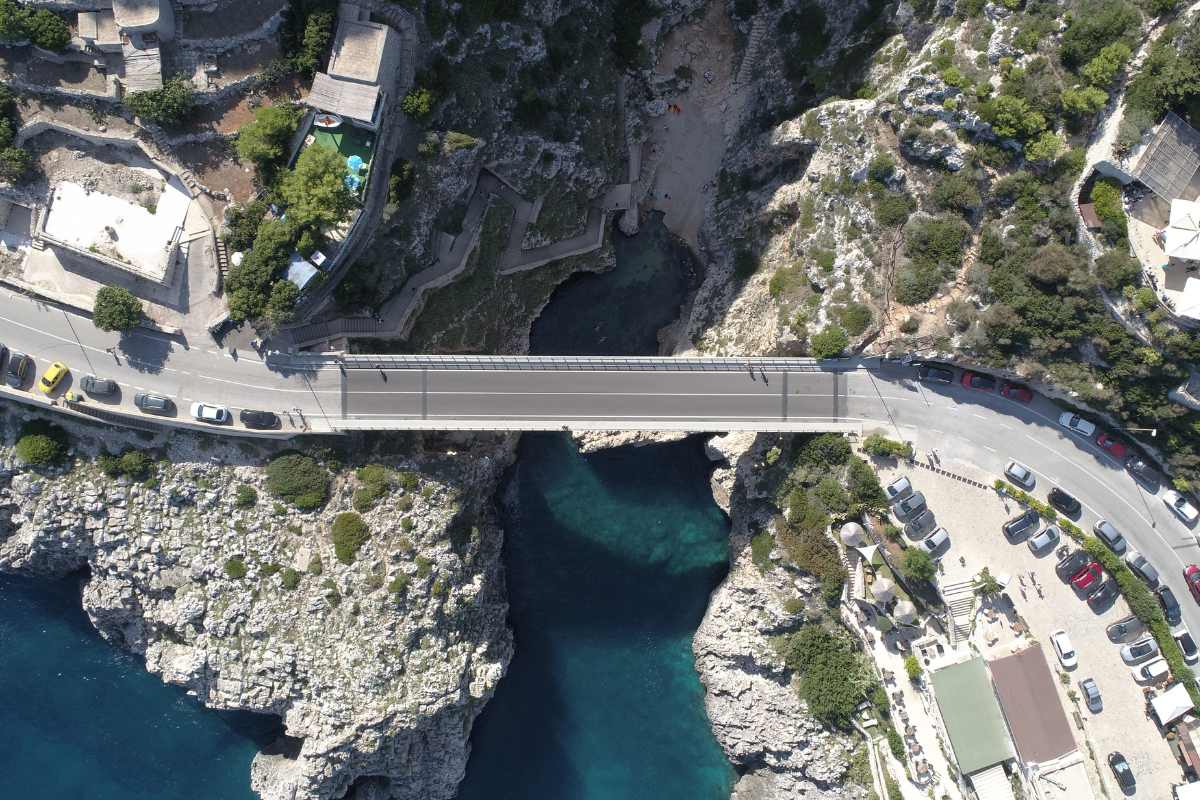
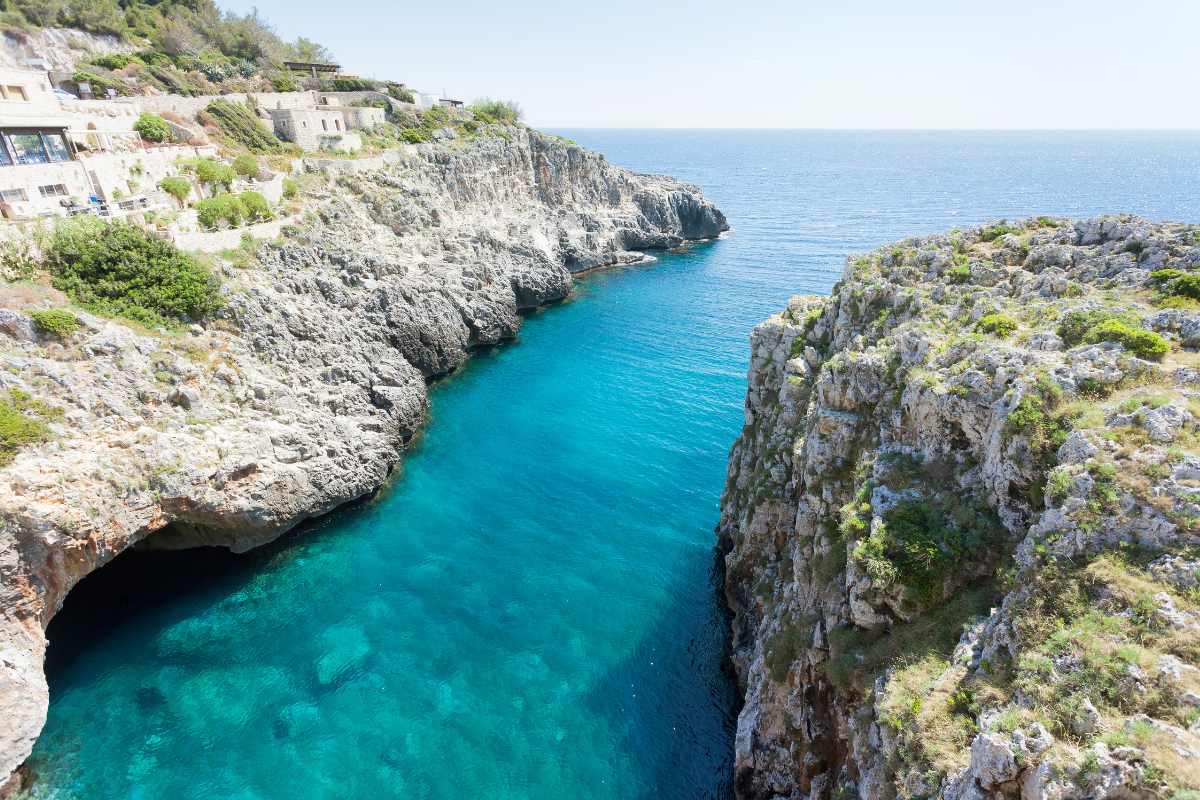
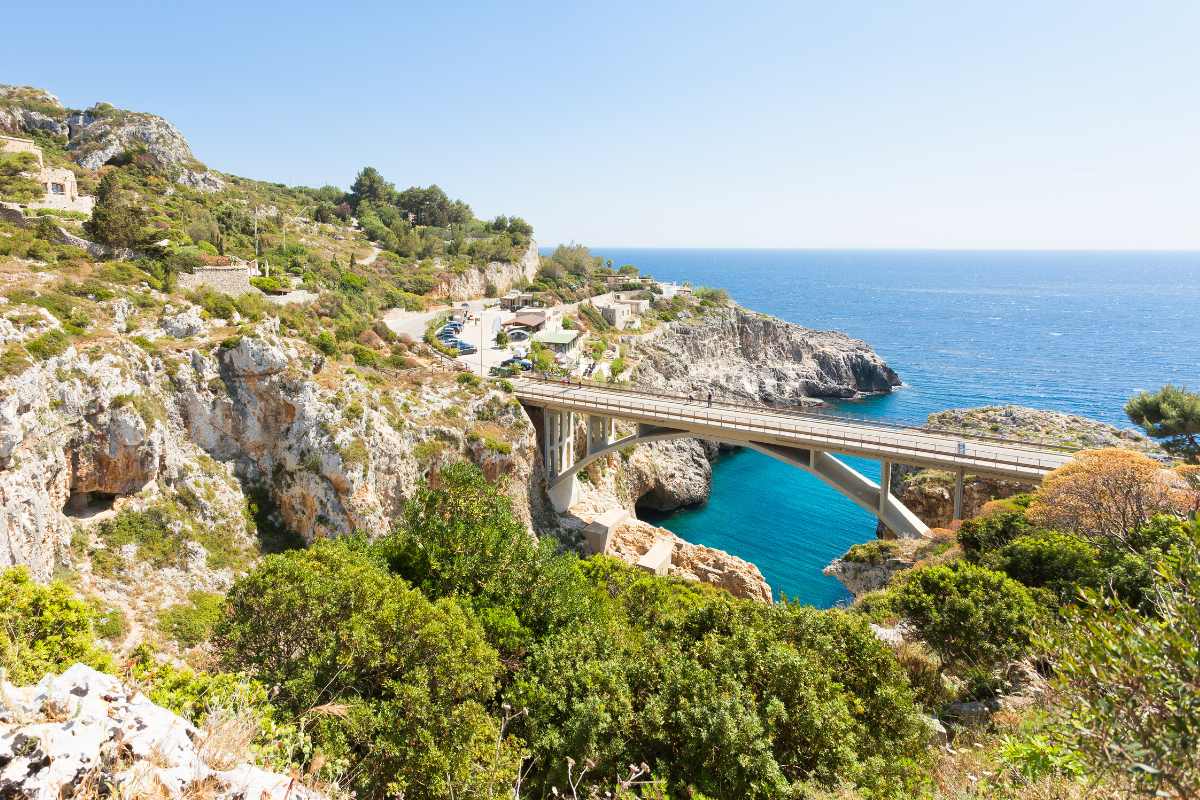
Ponte del Ciolo is one of the most suggestive iconic places in Salento and is located on the municipal territory of Gagliano del Capo. It is a architectural work, realized in the sixties, which overlooks a splendid inlet and connects two banks, that of Santa Maria di Leuca and that of Novaglie. From here you can enjoy a breathtaking view and a crazy scenery on the coasts of the Adriatic embraced by rugged and unspoiled nature. Take a dip in the crystal clear waters of Ciolo, becomes an immersive experience, ideal especially for diving and snorkeling enthusiasts.
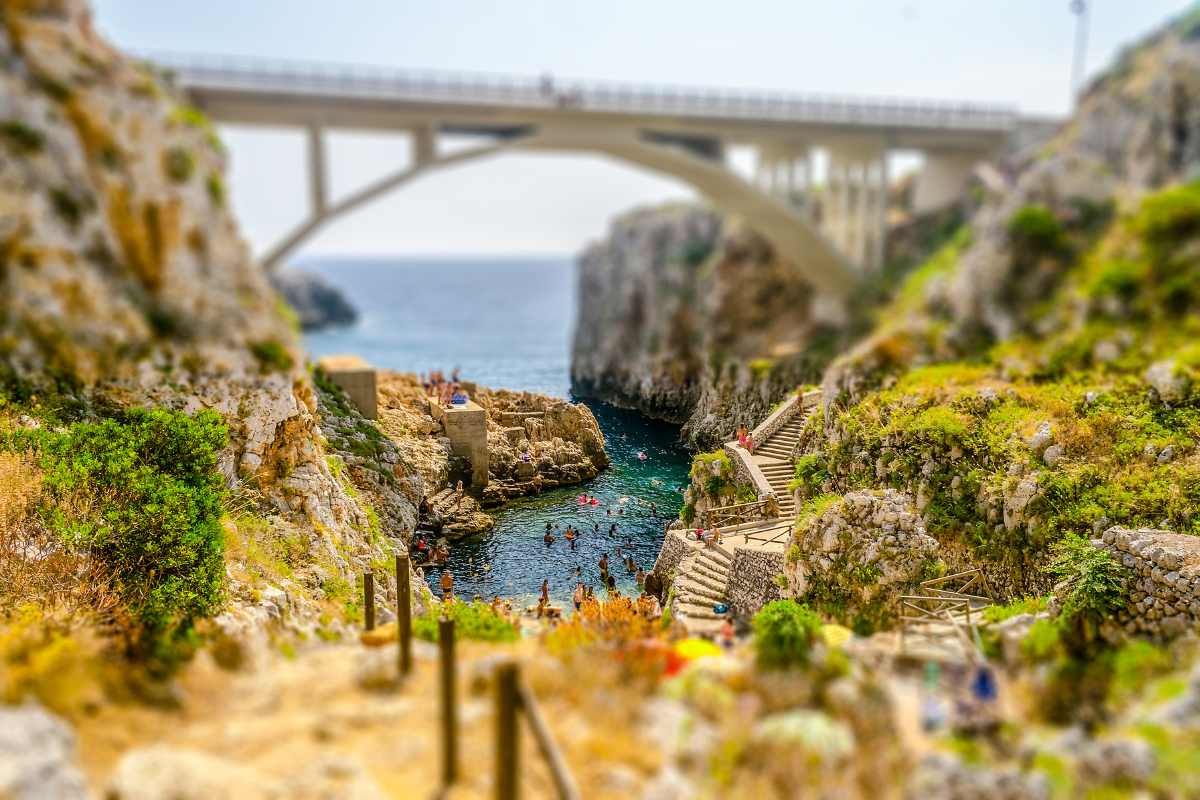
General information
Ciolo is a narrow coastal inlet located on the Adriatic side of Salento, in Puglia. This site, of great historical and environmental interest, is also known for its rich geology and the presence of numerous sea caves, among which stands out the majestic Grotta del Ciolo. Since October 2006, the area surrounding Ciolo has been included in the Parco Regionale “Costa Otranto – Santa Maria di Leuca e Bosco di Tricase“, established by the Region of Puglia in order to preserve the eastern coast of Salento, safeguarding not only its architectural heritage but also the valuable wildlife and plant species present.
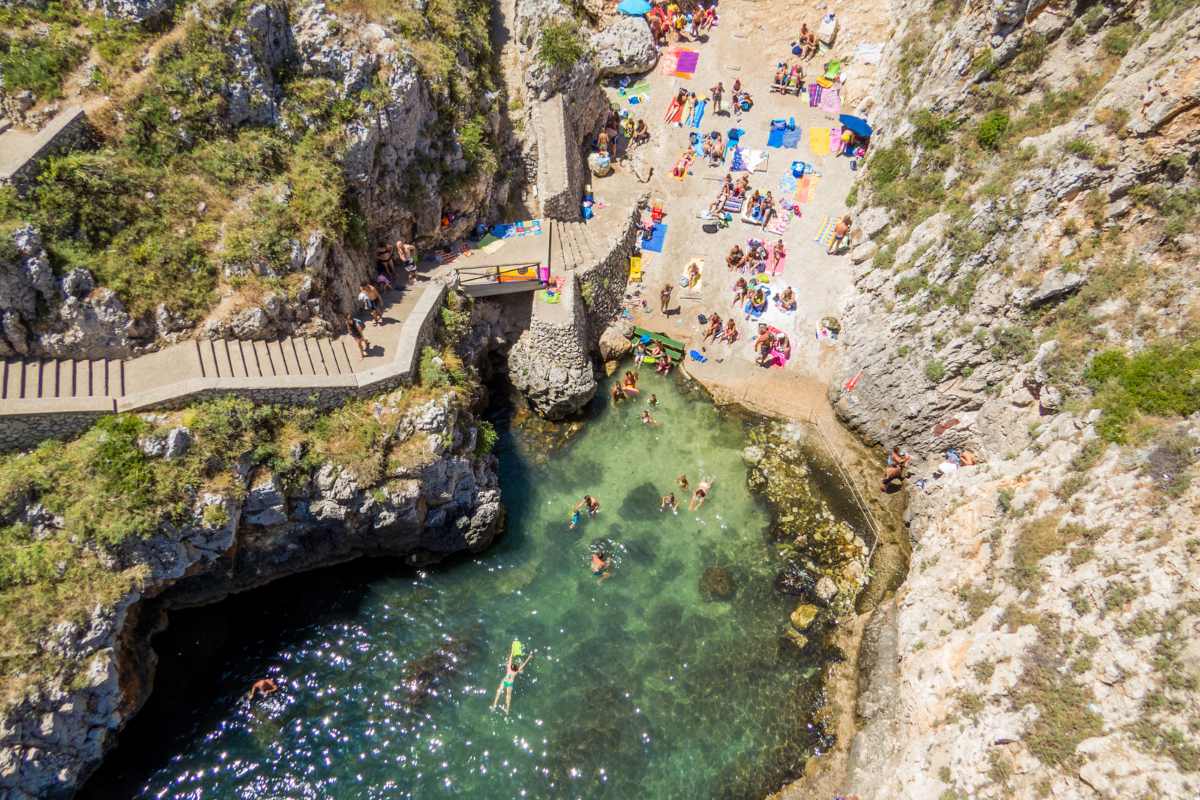
Just below the bridge opens this small cove, a narrow free beach characterized by gravel and concrete, almost always sheltered from the winds because protected by two rocky ridges.
Why is it called Ponte del Ciolo?
The name “Ciolo” comes from the dialect of Salento, “ciole”, which refers to ravens or magpies, birds very common in Salento, that fly on this wonderful fjord.
The history of Ponte del Ciolo
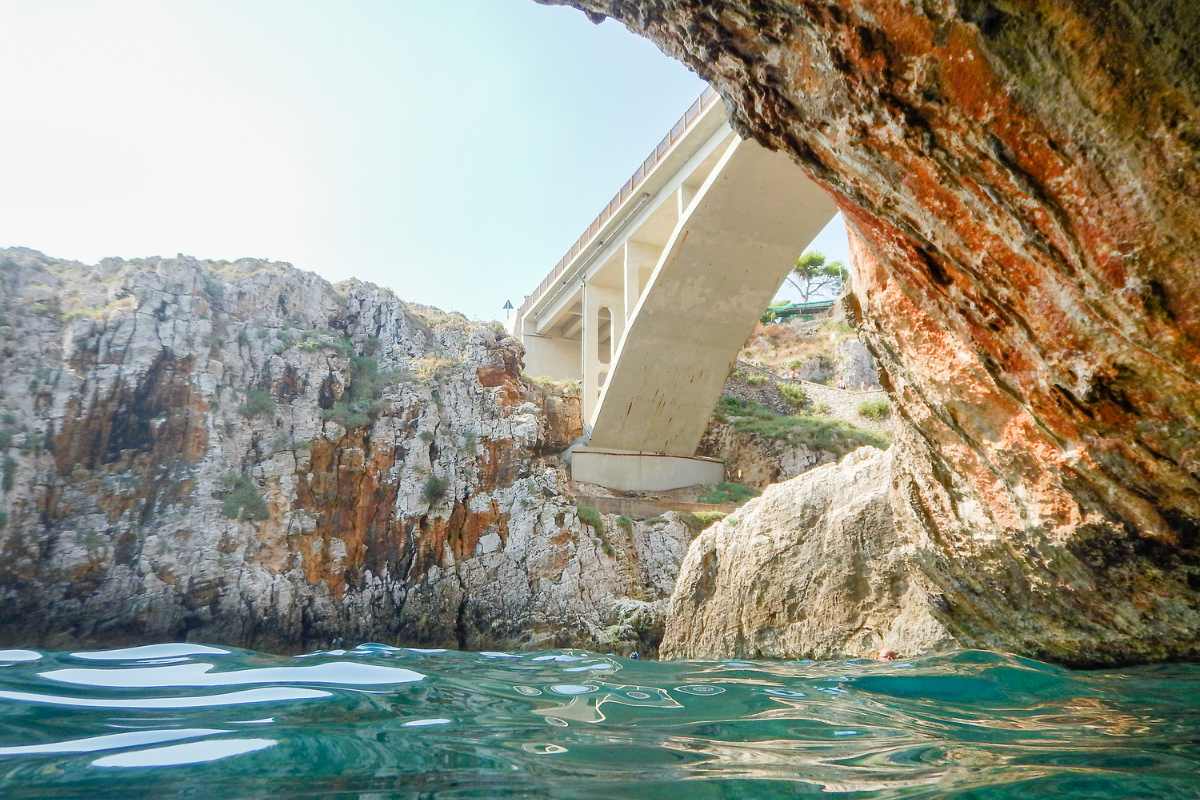
Ponte del Ciolo, the iconic structure that stands at about 30 meters above the water, is 60 meters long and 10 meters wide. Originally conceived as a bridge with two continuous spans, the initial project of engineer Mario Carrone had to undergo changes due to the impossibility of as highlighted in the geotechnical report of the professor and engineer Vincenzo Cotecchia.
So that the engineer Antonio La Tegola adopted the technique of the Swiss engineer Robert Maillart, which required the incorporation of a thin vault and a stiffening bridge, giving life to the Maillart Bridge.
Built between 1962 and 1967, it is a structural masterpiece and a symbol of innovation for the whole Puglia.
However, the passage of time has made necessary maintenance work, culminating in an ambitious rehabilitation project presented in March 2023 and financed with over 4 million euros by the Ministry of Infrastructure and Transport. This intervention not only preserved the original appearance and structural integrity of the bridge, but also introduced functional improvements, including a variable and multi-coloured lighting system and accessibility improvements for people with disabilities, including a barrier-free pedestrian path and a cycle lane, Together with protective barriers to avoid the famous dives of the Ciolo that have caused several accidents.
Ciolo’s caves
In the canyon of Ciolo there are several marine caves dating back to the Neolithic and Paleolithic, witnessing ancient human presence and millenary geological phenomena. Among the main caves in this area, we can highlight the Grotta Grande del Ciolo, the Grotta Piccola Del Ciolo and the Grotta Delle Prazziche, each with its own history and peculiarities. These natural formations add further interest and mystery to the already fascinating setting of the Ponte Ciolo.
Grotta Piccola del Ponte Ciolo
The Grotta Piccola del Ponte Ciolo, also known as “Grotta della foca monaca“, is one of the most fascinating attractions in the area. Located in the homonymous cove and semi-submerged, the entrance of the cave opens on the west side of the canyon, offering a unique spectacle towards the sea. With its more than 120 meters of linear development, the Grotta Piccola is one of the longest in the Salento peninsula, characterized by several rooms and a tiny beach at the end. The discovery of a monk seal inside, from which it derives its name, added a touch of mystery and charm to the cave, which continues to be the subject of biological studies conducted by various academic institutions.
Grotta Grande Del Ciolo
The Grotta Grande Del Ciolo, also known as Grotta degli Spiriti or Grotta dei Passeri, is another natural wonder of the canyon. Characterized by a large semi-submerged entrance, the cave extends for 120 meters longitudinally, with a high entrance over 30 meters. The presence of an internal pond fed by a fresh water source adds an element of suggestion to its charm. Not only a destination for explorers and tourists, but also a place of interest for scholars who continue to investigate its flora and fauna, the Grotta Grande Del Ciolo represents a reference point in the natural history of the region.
Grotta delle Prazziche
The Grotta Delle Prazziche can be reached by boat and is located near the Ponte del Ciolo, offering a unique experience. With its circular structure and the presence of a vertical siphon towards the open air in the upper part, this cave has attracted the attention not only of scholars but also of archaeologists. The numerous prehistoric finds found inside, including Neolithic artifacts and rhinoceros remains, testify to the human presence and historical importance of this area in past millennia.
Tips for visiting Ponte Ciolo
- Wear comfortable shoes: you are going to go on a hike or explore the caves, wear comfortable shoes.
- Bring water and snacks – there are no shops or restaurants near the Ciolo Bridge, so make sure you bring some water and something to eat.
- Be careful when swimming: the currents can be strong around the Ponte Ciolo, so be careful.
- Respect the environment: leave no waste and be environmentally friendly.
What to do near Ponte Ciolo?
In addition to being a wonderful place from the point of view of landscape, the Ponte del Ciolo allows you to live different experiences.
Trekking at the Ponte del Ciolo
It is particularly well known for the trekking trails in the surroundings, especially for the Sentiero delle Cipolliane, about 4 km long. You can access the path by a long staircase near the Ponte del Ciolo, which gives access to the small cove. Leaving the sea behind, the steep path leads up to Gagliano del Capo, crossing rocky cliffs that house numerous prehistoric caves. Along the route, surrounded by the typical Mediterranean landscape, you can admire rare plant species such as the Leuca’s Alisso, the Vicia Giacominiana and the Anagyris foetida, as well as several rare Orchidaceae species. Birdwatchers can spot migratory wading birds, grebes and pigeons, while the Queen’s Hawk is more rare. Along the way, you can also see several chapels and votive edicules dedicated to the Madonna di Leuca, which is a symbol of the area.
Diving and snorkeling
Other activities particularly practiced are the diving and the snorkeling, which allow access to coves and caves accessible only underwater.
Climbing
The crag of Ciolo is renowned as the main area for sport climbing in Salento. In 2013, it was chosen as the venue for the Salento Climbing Fest, a major event in the world of climbing. The rock wall was equipped with expansion plugs and fully re-equipped in 2013 as part of the Salento Verticale, thanks to the commitment of local climbers and the Ragni di Lecco Mountaineering Society. With over fifty routes available, ranging from 4 to 7b+ in difficulty, the Ciolo offers challenges for climbers of all levels. It is also a popular destination for the deep water soloing, a practice that involves climbing rocks over the water without protection, offering an exciting and adrenaline-pumping experience for enthusiasts.
Where it is located and how to reach Ponte Ciolo
The Ponte del Ciolo is located along the Adriatic coast of Salento, precisely in the municipality of Gagliano del Capo, in the province of Lecce, in Puglia. This spectacular bridge stands over the picturesque Ciolo Canyon, dominating the crystal clear waters of the Ionian Sea. Its geographical position offers a breathtaking panorama, with cliffs overlooking the sea and the bright colors of the surrounding nature that contribute to create an idyllic atmosphere.
The best way to reach the Ponte del Ciolo is by car, from Lecce take the SS16 for Maglie, continue on the SS275 arriving at Tricase and then continue towards Gagliano del Capo on the SP358.