The historic center of Lecce is not just a place to visit: it is an experience to live, a labyrinth of golden stone that tells centuries of art, faith and splendor. As soon as you cross its ancient doors, you realize that every corner has something to whisper: a story carved on a portal, a baroque detail that captures the eye, an atmosphere that seems suspended in time.
If you love art and history, this is your place. But even if you don’t know it yet, the historic center of Lecce will conquer you, with its warm and generous beauty, capable of welcoming and surprising anyone who passes by here.
In this article we will accompany you through its wonders: step by step, you will discover why Lecce is not just visited… Lecce is felt, breathed, and is difficult to forget.

General information on the historic center of Lecce
Lecce is located in the heart of Salento and is often called the “capital of Baroque” for the richness of its architectural decorations in this style. The historic center of Lecce coincides with the nucleus surrounded by the ancient walls, a small area that can be easily visited on foot.
The historic center of Lecce is not large, but it is a concentration of wonders. In less than half an hour you could cross it from one end to the other, so close are the monuments, churches and buildings, interspersed with quiet squares and welcoming cafes where you can take a break. But don’t let its compact size fool you: to truly grasp its essence, it’s worth taking the time you need. One or two days can be enough to discover its main stages and let yourself be enchanted by its timeless charm.
The Lecce stone is the secret of Lecce’s baroque triumph: a soft, golden-colored limestone that craftsmen have sculpted into spectacular facades full of scrolls, cherubs, and floral motifs.
The city boasts dozens of churches (about forty in the center alone!) and numerous noble palaces, testifying to its centuries-old history. The historic center – old Lecce – is alive at all hours: during the day it shows off its art treasures in full light to the many visitors, in the evening it comes alive with soft lights and outdoor restaurants.
What to see in the historic center of Lecce
What is there in the historic center of Lecce? As soon as you cross one of the three city gates, you find yourself in a labyrinth of cobbled streets where a new wonder appears at every turn.
The beauty is that the centerof Lecce is not just a succession of monuments, but a lively point of interest where everyday life coexists with art. At every step there is always a hidden square to discover, a monument or an artisan workshop. Take your time and let yourself be surprised: we are sure that you will be enchanted.
Monuments and Churches
Lecce Cathedral and Piazza del Duomo
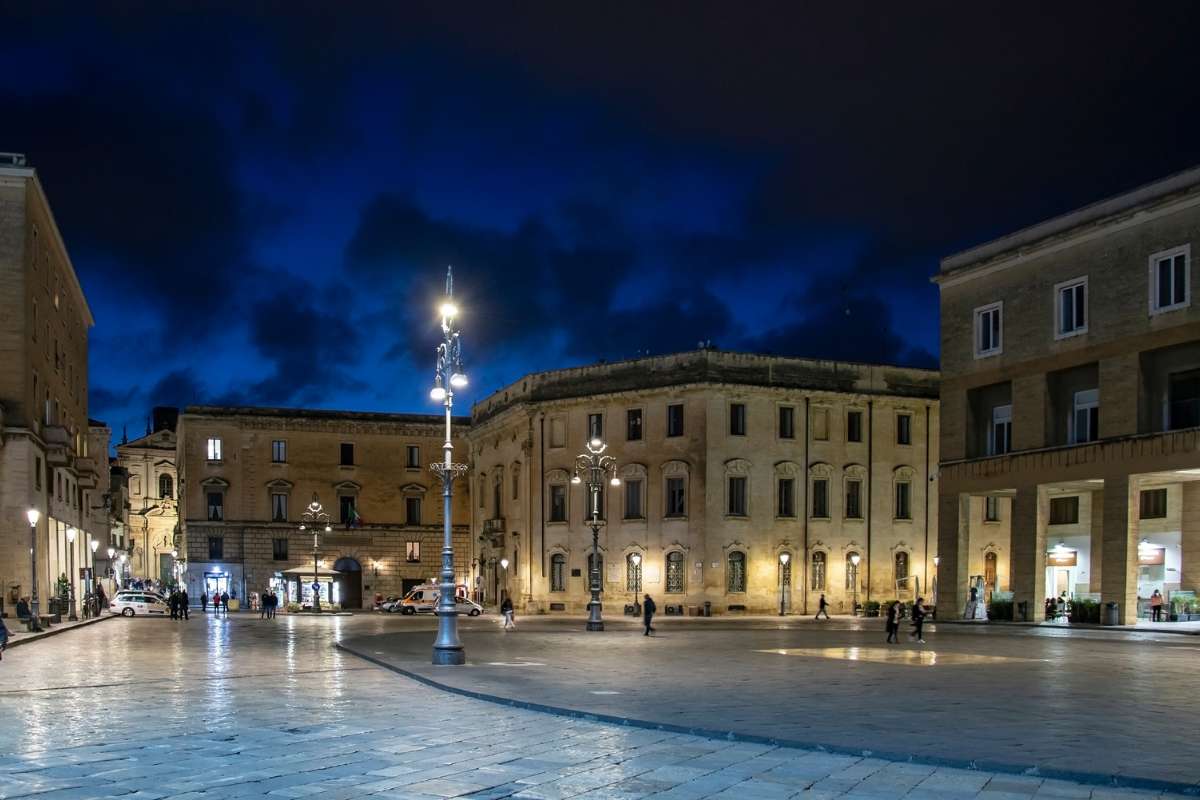
The Cathedral of Maria Santissima Assunta is the spiritual soul of the city and one of the most majestic examples of Lecce Baroque. The main body has two facades and the main entrance overlooks the suggestive Piazza del Duomo, a closed square that becomes an open-air lounge in the evening.
The cathedral is flanked by a tall bell tower and other elegant baroque buildings that create an overall picture of strong emotional impact. The interior is characterized by rich marble altars and decorations that shine in the dim light of the naves.

Basilica of Santa Croce
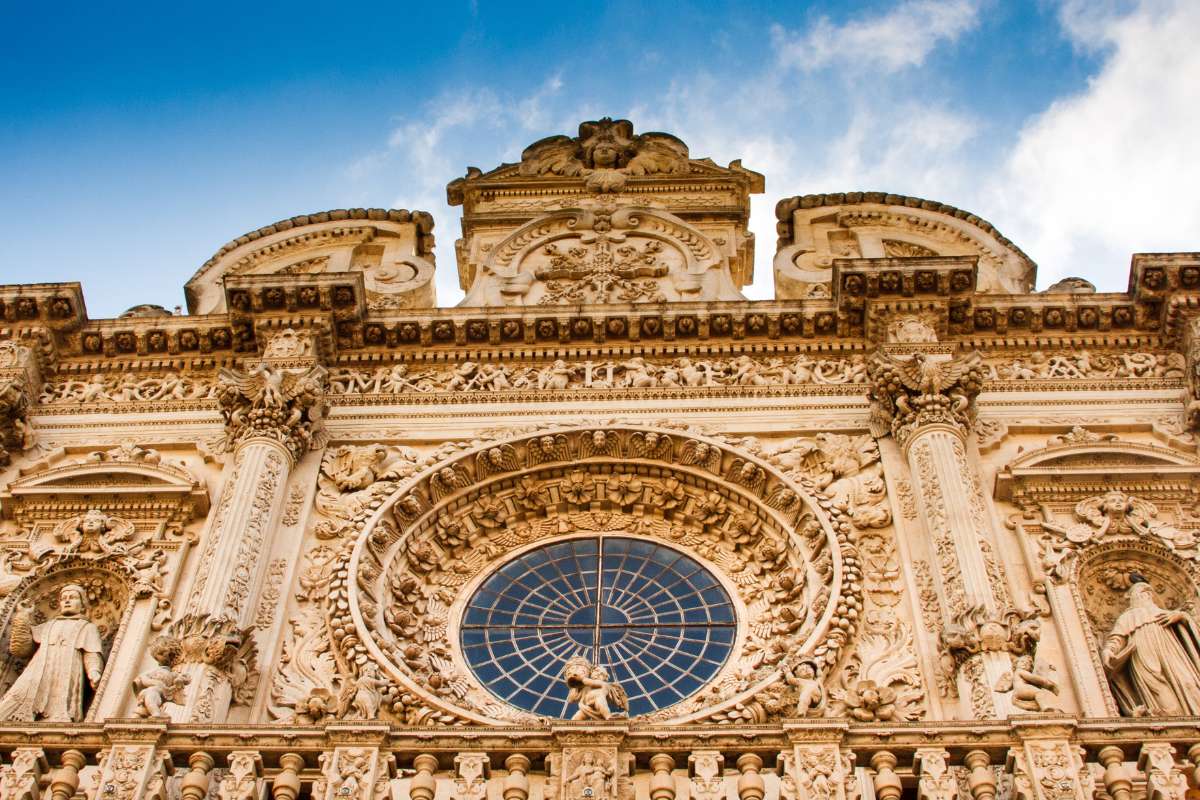
The undisputed symbol of Lecce, the Basilica of Santa Croce surprises with its spectacular facade, a true manifesto of local Baroque. You will be enchanted by the riot of decorations: figures of animals and fantastic creatures, spirals and stone flowers that frame a large central rose window like sculpted lace.
The interior, more sober, maintains an elegant harmony. Right next door is the former Celestine Convent, now the seat of the Prefecture.
Church of San Matteo
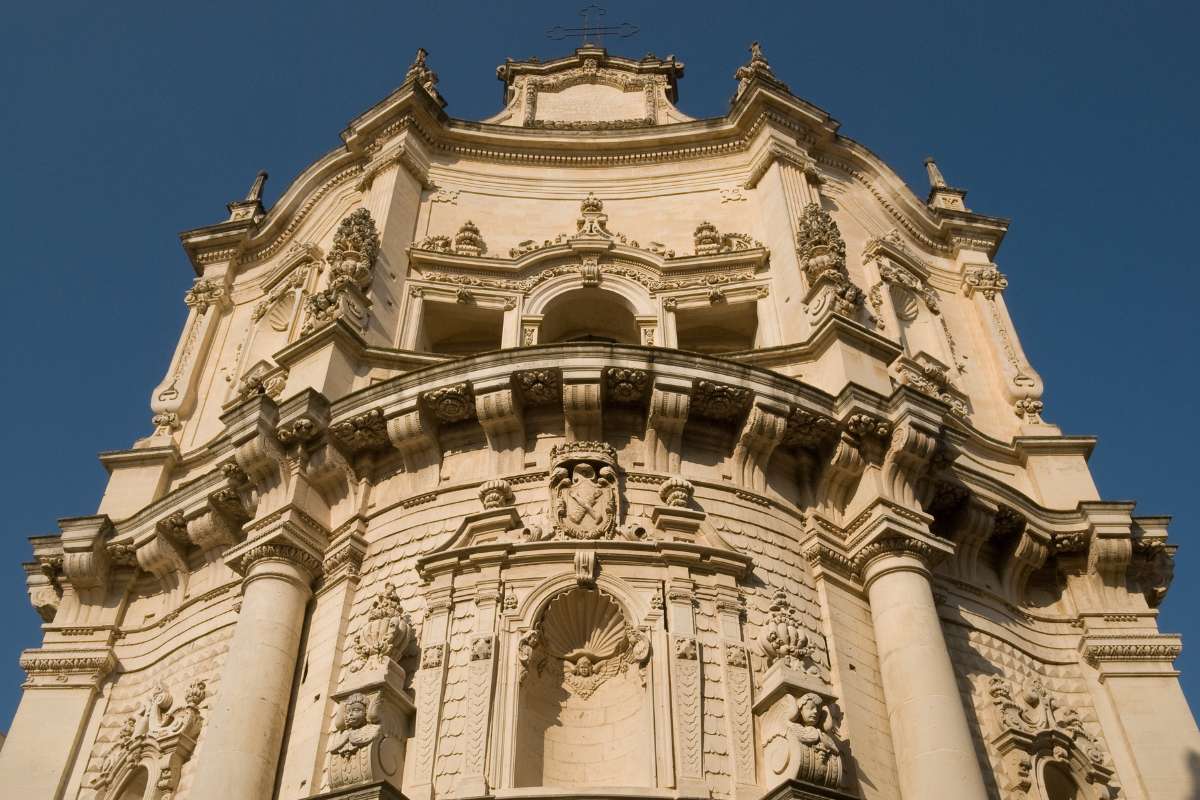
Hidden in an alley, the Church of San Matteo dates back to the second half of the seventeenth century and is striking for its unusual wavy façade, with concave and convex shapes that play with the light.
The interior has an unusual elliptical plan and develops in a single oval nave with richly decorated altars that create an intimate and cozy atmosphere, different from the other churches in the city.
Church of Santa Chiara
Overlooking a small square not far from Sant’Oronzo, the Church of Santa Chiarahas a simple and elegant façade.
Upon entering, you will be struck by the bright coffered ceiling in painted papier-mâché, an ingenious trompe-l’œil that imitates carved wood. This artistic device, very common in Lecce, lightens the structure and shows all the skill of the workers employed in the construction.
Church of Saints Nicolò and Cataldo
Founded in 1180 by the Normans, the Church of Saints Nicolò and Cataldo is one of the oldest churches in Lecce. It is located just off the beaten path, surrounded by centuries-old trees.
The façade reveals a mix of different styles and medieval Romanesque-Gothic elements blend with Baroque decorations added in the eighteenth century, a rare combination in these parts.
Inside, there is an aura of ancient spirituality, far from the hustle and bustle of the center.
Archaeological Sites
Roman Amphitheater
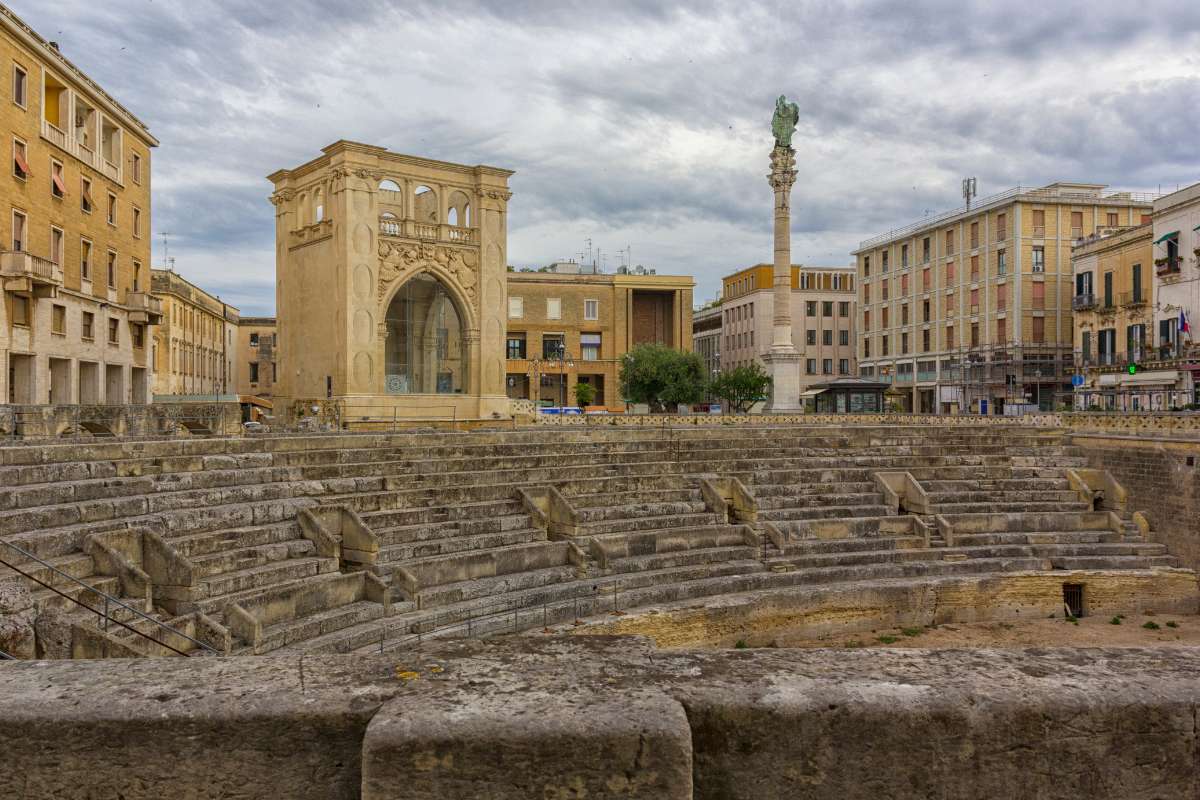
In the middle of Piazza Sant’Oronzo, the thousand-year-old steps of theRoman Amphitheater dating back to the 2nd century AD peep out.
It could originally accommodate up to 20,000 spectators. Today you can admire a portion of it, but it is enough to imagine what life was like for the gladiators when they went down to the arena.
In the evening, the lighting enhances its charm and almost seems to perceive the echo of ancient shows.
Roman Theater
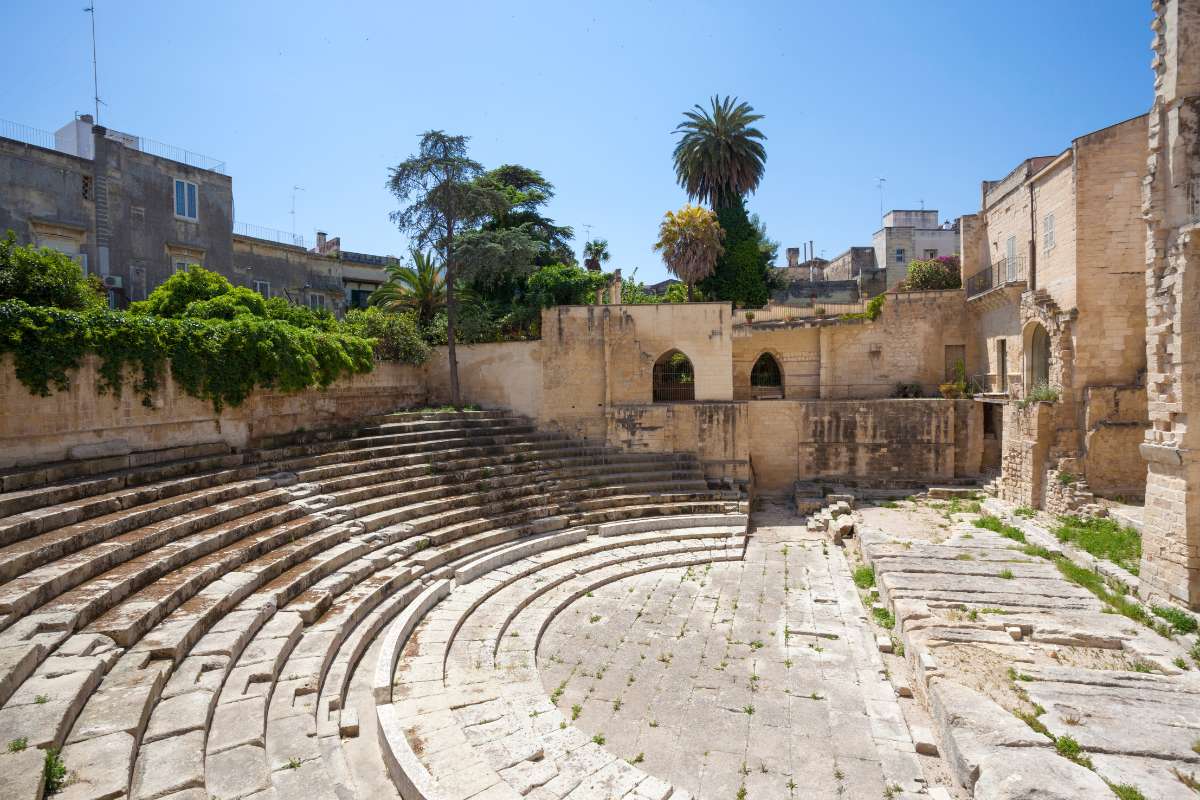
Behind Piazza Sant’Oronzo there is a smaller Roman Theater, discovered in 1929, which could accommodate about 5,000 spectators.
Today its semicircular steps emerge between the modern houses, creating a suggestive contrast. A small museum nearby displays the finds, helping you imagine what life was once like in Lupiae (Lecce in Roman times).
Urbiche Walls and Porta Napoli
North of the historic center you can admire a stretch of the Urbiche Walls, the ancient city walls dating back to the sixteenth century built for defensive purposes by Charles V next to Porta Napoli, a monumental triumphal arch erected in 1548.
Crossing Porta Napoli is like entering another era and observing these mighty fortifications you can understand how Lecce was once a fortress-city much feared by enemies.

Historical Palaces and Museums
Castle of Charles V
Next to Piazza Sant’Oronzo stands the castle commissioned by Emperor Charles V around 1540, a massive fortress characterized by angular bastions.
Today it hosts art exhibitions and cultural events and inside it is the Museo della Cartapesta, dedicated to the traditional art of Lecce.
Palazzo dei Celestini
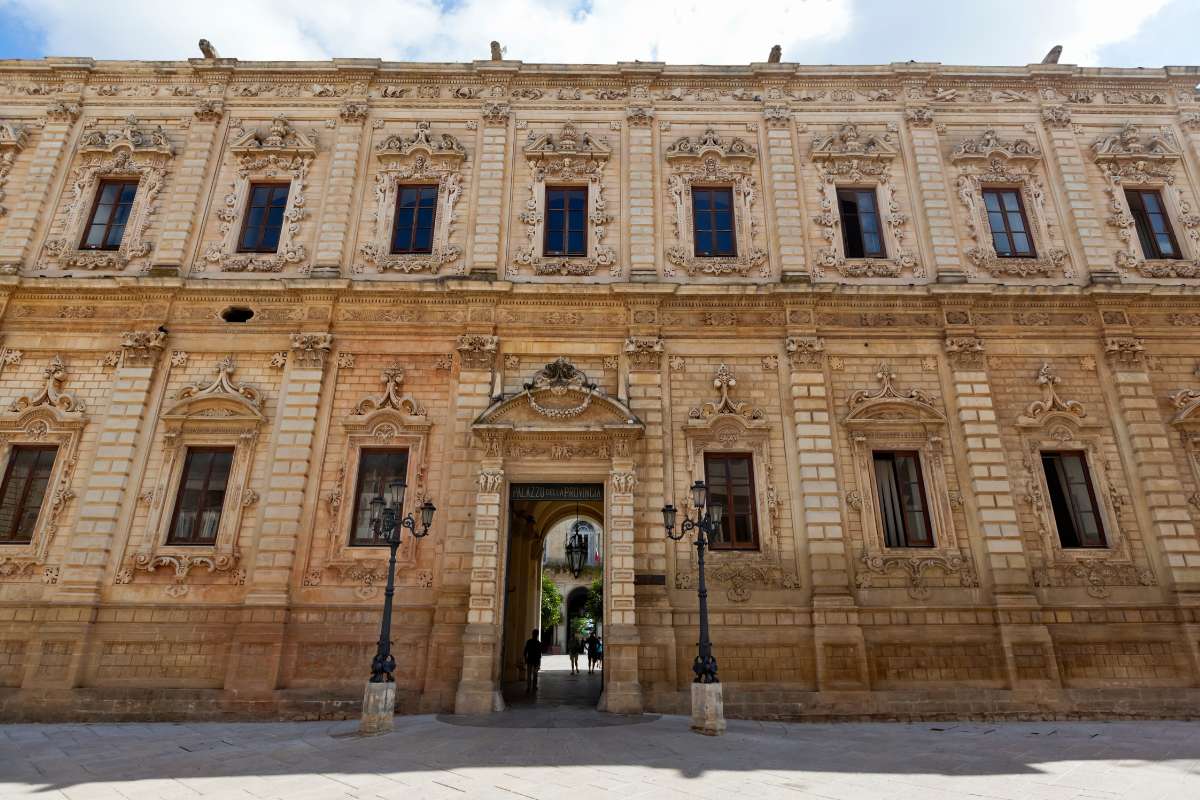
Adjacent to the Basilica of Santa Croce, Palazzo dei Celestini is a former seventeenth-century convent characterized by a very refined baroque façade that today houses the Prefecture.
Richly decorated but more sober than the nearby church, the palace forms a harmonious whole with it and is one of the symbols of the religious and civil power of Lecce in the Baroque era.
Faggiano Museum
Among the alleys is the curious Faggiano Museum, a private house transformed into a museum after an archaeological discovery accidental.
During renovation work, some medieval cisterns, tombs and a floor dating back to Roman times emerged under the floor. It is possible to go down into the underground and admire these important stratifications with your own eyes.
MUST – Historical Museum of the City of Lecce
The MUST, housed in a former convent in the historic center of Lecce, offers a multimedia journey that traces the history of Lecce.
Ancient maps, vintage photographs and interactive installations tell the story of the city from its Messapian origins to the Baroque era, placing what you have seen on the streets in the right historical context.
Squares and Places of Interest
Piazza Sant’Oronzo
Piazza Sant’Oronzo is the main square of Lecce dominated by the Roman column on top of which stands the statue of Sant’Oronzo, patron saint of the city.
In the centre, just below street level, the arches of the Roman Amphitheatre emerge. Around you will find historic cafes, shops and the ancient Palazzo del Seggio, known as Sedile.
Via Palmieri
Via Palmieri connects It takes Naples to the heart of the old city, offering a walk among noble palaces and monumental portals. Along the way you can glimpse hidden courtyards, breathing an atmosphere of times gone by.
Porta Rudiae
On the west side, Porta Rudiae is an imposing baroque arch surmounted by the statues of Sant’Oronzo and other patron saints of Lecce.
It owes its name to the ancient Messapian city of Rudiae, towards which the road led. It is one of the most scenic entrances to the old city and certainly deserves a souvenir photo.
Porta San Biagio
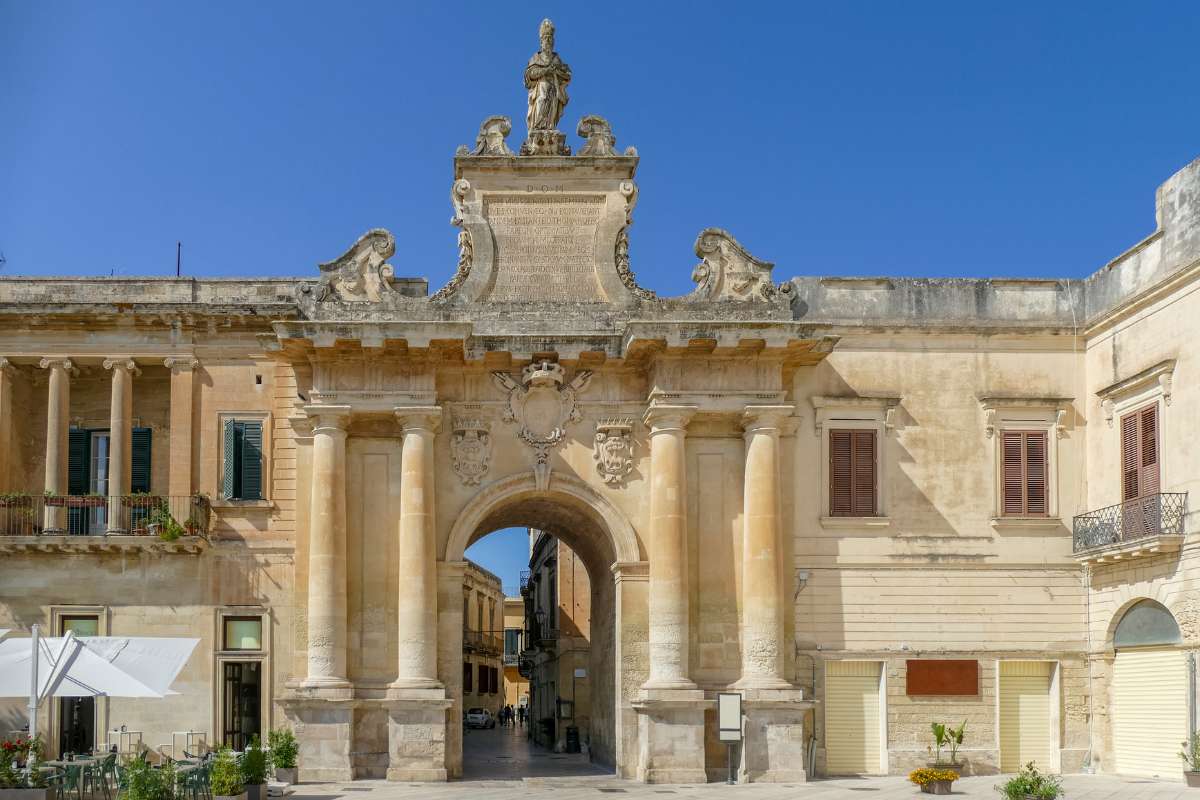
To the south of the historic center opens Porta San Biagio, dedicated to the saint of the same name. This arch, also baroque and surmounted by the statue of San Biagio, marked the entrance to the south of Salento.
Villa Comunale Giuseppe Garibaldi
Just outside the historic center of Lecce, there is the Villa Comunale, a delightful nineteenth-century public garden.
With tree-lined avenues, well-kept flowerbeds and shaded benches, the park is perfect for a break in the greenery.
Sitting on a bench in the shade of the pine trees, with the chirping of birds in the background, is the perfect opportunity to relax and think about the beauties you have just seen before continuing your tour.
Shopping and crafts
The historic center of Lecce offers many opportunities for shopping, especially for those who want to take home a handmade souvenir.
The city is famous mainly for ancient arts such as papier-mâché, wrought iron and Lecce stone. In the shops of the historic center you can see the artisans at work and, if you love craftsmanship, buying an artifact will be like taking a piece of Lecce with you.
For more classic shopping, head to Via Trinchese, the pedestrian street that leads from Piazza Sant’Oronzo to the new city, lined with boutiques, ice cream parlors and fashion shops.
For an evening stroll there is Corso Vittorio Emanuele II which crosses the entire historic center of Lecce.
How to visit the historic center of Lecce
To visit the historic center of Lecce in a complete and engaging way, we recommend the Lecce Ecclesiae itinerary. This route allows you to explore the most representative churches of Lecce Baroque with a single ticket, enriching the walk through alleys and squares with stops in authentic architectural jewels. A perfect way to discover the historical and spiritual soul of the city, accompanied by multimedia content and precious information that make the experience even more immersive.
Where is the historic center of Lecce and how to reach it
Lecce is located in the extreme south of Puglia, in the famous “heel of Italy”. Reaching the historic center of Lecce is easy thanks to good connections.
If you arrive by plane, Brindisi airport (about 40 km north) offers frequent shuttles that will take you to the city in less than an hour.
By train, Lecce is the terminus of the Adriatic line: from Lecce Station you can reach the historic center with a 15-minute walk.
If you travel by car, from Bari or Brindisi take the highway to Lecce; once you arrive, it is best to park outside the walls (for example near Porta Napoli) because the center is a Limited Traffic Zone and you can easily get around on foot. There are several car parks, both private and municipal, with different rates depending on the area. Usually on Sundays you don’t have to pay the ticket, but always check!