Far from the most touristic routes of Salento lies a site of considerable historical and cultural interest that holds age-old secrets, ready to reveal themselves to travellers willing to look beyond the surface.
The Grotta delle Veneri di Parabita is one of those places that allows you to take a dip back in time, when prehistoric man inhabited these lands and worshipped deities linked to fertility and nature.
If you find yourself in the ancient “Terra d’Otranto”, the Parco archeologico di Parabita is an unmissable stop to live an experience that goes beyond the beauty of the landscapes and discover a piece of history that few know.
General Information
The Grotta delle Veneri di Parabita is an archaeological site located in the heart of Salento, in the territory of the municipality of the same name, in the province of Lecce.
The karst cavity takes its name from the famous Prehistoric Venuses, small bone statuettes depicting female figures, a symbol of fertility and now preserved at the National Archaeological Museum of Taranto, where they continue to tell the story of a people who venerated femininity as a sacred principle of life.
The Grotta delle Veneri is part of the Parabita Archaeological Park, which includes other areas of great historical interest, and which offers visitors the opportunity to fully immerse themselves in the atmosphere of a past that seems to resist over time.
History of the Cave of the Venuses of Parabita
The history of the Cave of the Venuses of Parabita is closely linked to that of the prehistory of Salento and has been inhabited since the time of Neanderthal man, as demonstrated by the findings made during the excavations.
The cave consists of a first room of small dimensions, followed by a tunnel that develops in a T shape for about one hundred meters. Outside there is a second room, known as the shelter cave, which was probably formed following collapses.
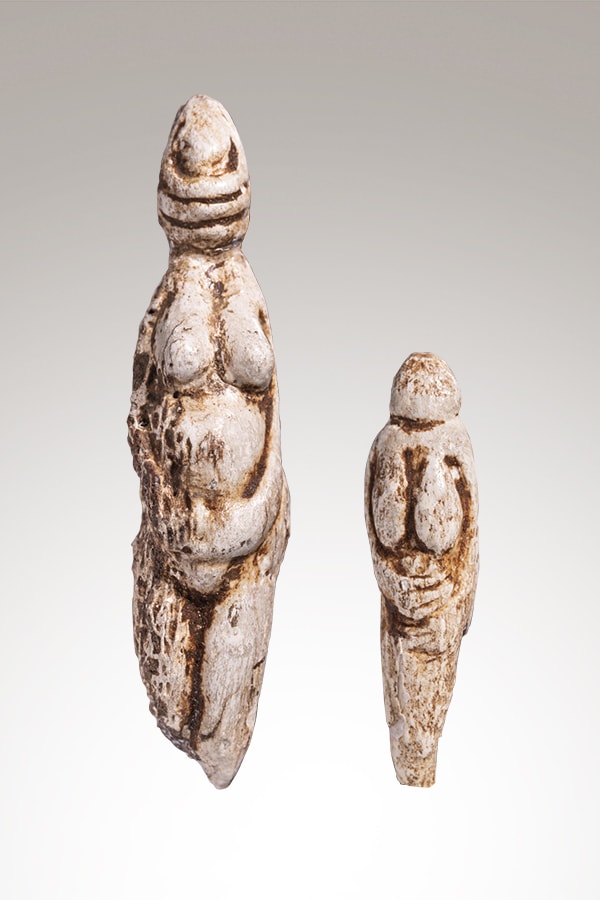
The two bone figurines, found in the cavity, represent some of the most fascinating and significant finds of the prehistoric site. Sculpted in natural materials, these standing female figures embody ancient religious and symbolic practices related to fertility.
The largest figurine, 9 cm high and 2.1 cm wide, is carved from a long bone of a large herbivore, probably a Bos primigenius or an Equus caballus. The incredibly detailed figure has a face that appears to be covered by a veil, perhaps a hairstyle or a mask. The arms, positioned under the belly, suggest the representation of a pregnant woman. Furthermore, the figurine shows a perforation at the lower end, which suggests that it may have had a decorative or ritual function.
From a stylistic point of view, the figurine shows traits that connect it to similar figurines found in other European areas, such as the Mediterranean, the Rhine-Danubian area and Russia, highlighting common influences in the treatment of prehistoric female figures.
The second figurine, smaller (6.1 cm high and 1.5 cm wide), although made with less detail, has a similar design. Here too, a pregnant woman is depicted, with her arms placed under her belly. Although its workmanship is simpler, the figurine fits into a stylistic context that finds comparisons both in Eastern Europe, for the posture of the arms, and in Western Europe, for the shape of the face. It is possible that its function was that of a decorative tool or amulet.
Over the centuries, the cave continued to be used as a refuge and place of worship, and excavations have brought to light numerous other finds, including stone tools, bones and human remains. These finds have allowed us to reconstruct the daily life of the prehistoric inhabitants of the area and to better understand their beliefs and spiritual practices.
The Grotta delle Veneri is today a precious archaeological heritage that testifies to the cultural evolution of Salento from a religious and social point of view.
Prices and opening hours of the Grotta delle Veneri in Parabita
Although the Grotta delle Veneri in Parabitacannot currently be visited, as a safe access route for the public has not been prepared, the Parabita Archaeological Park still offers many possibilities for exploration.
Entrance to the park is free and allows you to discover a rich variety of evidence of rock civilization, including fossil remains of prehistoric fauna, rare species of Mediterranean flora and traditional rural architecture. Inside the park, you can also visit stone extraction sites and a village dating back to the Bronze Age, which add further historical and cultural value to the visit.
Where is the Grotta delle Veneri di Parabita and how to reach it
The Grotta delle Veneri di Parabitais located in the municipality of Parabita, in the south of Salento. To get there, you can take the SS101 that connects Lecce to Gallipoli and continue to Parabita, following the signs for the archaeological site. The cave is easily reached on foot and the route is well signposted.
If you prefer to reach the site by public transport, you can take a bus from Lecce or Gallipoli but in this case it is best to check the timetables in advance.
If you are a lover of outdoor walks, we recommend you also explore the surroundings, as the area offers magnificent rural landscapes.
Curiosities about the Grotta delle Veneri of Parabita
The Grotta delle Veneri of Parabita is considered a true window to the past, which allows us to understand the deepest roots of our culture.
If you wonder what the meaningof the Venus statues is, the answer is still shrouded in mystery: probably, the statuetteswere used during fertility rituals but we cannot be sure. What is certain is that these artefacts are unique testimonies of a culture that lived in symbiosis with the earth and its laws.
Today, the Venus of Parabitaare the subject of study by historians, archaeologists and prehistory enthusiasts and the site itself is one of the fundamental stops on an archaeological journey that winds through Salento.
Things to do in the area
In addition to visiting the archaeological area that houses the Grotta delle Veneri di Parabita, the area offers numerous other activities that will make your stay even more interesting.
For example, we recommend visiting the historic center of Parabita, which preserves traces of its Norman origins, with ancient churches and buildings, such as the Castello Angioino.
The proximity to Gallipoli also offers the opportunity to enjoy the beautiful beaches of Salento, where you can relax after a day dedicated to culture.