The Lecce Cathedral is one of the most iconic places in the city, a masterpiece of art and history that attracts thousands of visitors every year.
Its grandeur is the result of a long process of construction and restoration and today it represents the tangible symbol of the soul of the city, a point of reference that reflects all the mastery of the Lecce Baroque.
If you appreciate its grandeur, you will discover that its beauty is not only external: inside, the atmosphere is dense with spirituality and the Lecce stone frames every detail.

General information
Also known as the Cathedral of Santa Maria Assunta, the Lecce Cathedral is located in Piazza del Duomo di Lecce, one of the most evocative and fascinating public spaces in the historic center.
Its location, in the center of the lively square, makes it easily reachable on foot from all the main points of interest and, despite its imposing size, the Duomo manages to integrate harmoniously with the surrounding architecture, creating an atmosphere of great suggestion.
The church is a must-see for those visiting Lecce, not only for its religious importance, but also for its immense artistic and cultural value. Every year, in fact, thousands of tourists and pilgrims go to the Cathedral attracted by the magnificence of its architecture and the richness of its history.
History of the Cathedral of Lecce
The history of the Cathedral of Lecce begins in 1144, when the bishop Formoso Lubelli built the first cathedral church of the diocese. In 1230, on the initiative of Bishop Roberto Voltorico, the cathedral was renovated and rebuilt in the Romanesque style, marking an important change in the religious architecture of the city.
It was only in 1659, at the behest of the bishop Luigi Pappacoda, that a new phase of renovation was undertaken. The task of designing the reconstruction was entrusted to the Lecce architect Giuseppe Zimbalo, known as lo Zingarello, who chose to keep the plan of the Romanesque cathedral intact, thus preserving the original structure.
The first stone was laid on January 1 of the same year and work continued until 1670, when the new cathedral, renovated in the Lecce Baroquestyle, was solemnly consecrated by the bishop Pappacoda, thus marking the birth of the imposing building, which still dominates Piazza del Duomo in Lecce.
Interior and exterior architecture
The architecture of the Cathedral of Lecce is an extraordinary example of Baroque, which not only characterizes the church, but also defines the entire square in which it stands.
The facade of the Cathedral of Lecce is a triumph of decorations in Lecce stone, enriched by columns, sculptures and floral motifs that express all the majesty and elegance of this artistic movement. Its perfect symmetry and attention to detail tell the extraordinary skill of the craftsmen who contributed to its construction, leaving an architectural legacy of inestimable value.

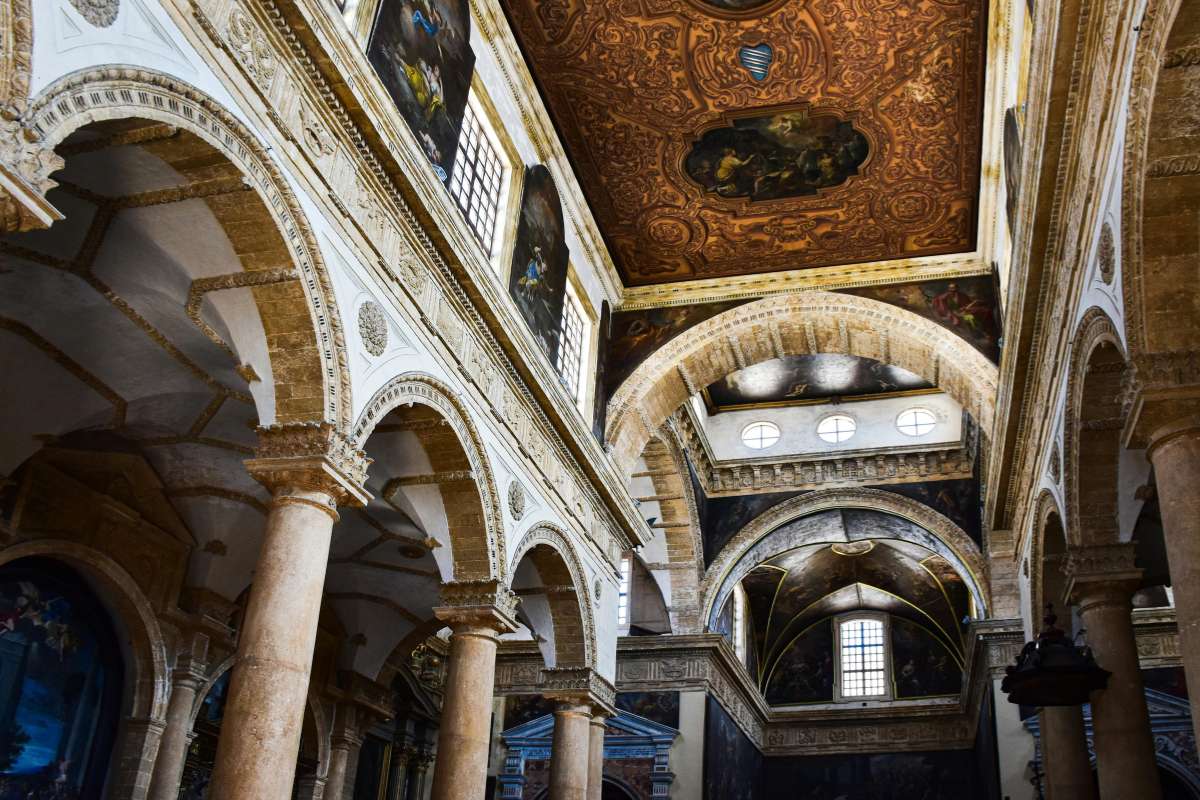
Entering the interior of the Cathedral of Lecce, attention is immediately captured by the imposing central nave, dominated by a magnificent wooden ceiling with carved coffers. The walls, adorned with statues of saints and decorated altars, envelop the visitor in an atmosphere of solemn beauty. Each decorative element seems to want to transport the observer into a timeless dimension, where art and spirituality blend in perfect harmony.
The Bell Tower of the Cathedral of Lecce
One of the distinctive elements of the cathedral is, without a doubt, the bell tower of the Cathedral of Lecce, which stands imposingly over the square and represents one of the best panoramic points of the city.
With its 70 meters high, the bell tower offers a spectacular view of Lecce. Its slender structure, which elegantly rises above the complex, is a perfect example of Baroque architecture, enriched by windows and sculptural details that enhance its verticality.
Its construction began in 1661, at the behest of the bishop Luigi Pappacoda, to replace the previous Norman bell tower, which collapsed in the early seventeenth century.
The bell tower of the cathedral stands on five floors, with a square base that progressively narrows, giving it an imposing appearance. The top floor is crowned by an octagonal dome decorated with majolica, on which stands an iron statue depicting Sant’Oronzo, the patron saint of the city.
The lower four floors feature elegant mullioned windows, each flanked by balustrades that give the tower the appearance of long panoramic balconies. To further embellish the structure, there are Latin epigraphs engraved on plaques, written by the Lecce scholar Giovanni Camillo Palma and positioned above the single-lancet windows.
A curious detail is the slight curvature to the left of the tower, due to a slight subsidence of the foundations, an irregularity that increases its charm and uniqueness.
Climbing to the top is an unmissable experience, especially at sunset, when the golden light envelops the city in a magical atmosphere.
Attualmente, l’access to the bell tower is suspended due to restoration and consolidation work.

Prices and opening hours of the Lecce Cathedral
If you are planning a visit to the Lecce Cathedral, it is useful to know the prices and the opening times.
The entrance ticket costs 11 Euros and includes a visit to the Ancient Seminary, Diocesan Museum, Museum of Sacred Art, Basilica of Santa Croce, Church of Santa Chiara and Church of San Matteo. The bell tower, however, requires a separate ticket.
Theopening hours of the Lecce Cathedral vary according to the season and religious events but, generally, the church is open every day, with visiting hours between 9am and 6pm (winter time) and 9am and 9pm (summer time).
It is always a good idea to check the updatedhours on the official website of the Cathedral before visiting, as there may be variations for special ceremonies or religious holidays.
Where is the Cathedral of Lecce and how to get there
The Cathedral of Lecceis located in the heart of the historic center of the city, in the square of the same name. Getting there is easy, as the square is located a few steps from Piazza Sant’Oronzo, the beating heart of Lecce.
If you are in the center, you can reach the square on foot, admiring the other architectural wonders that dot the city.
If you arrive in Lecce by car, you will find several parking options just outside the historic center.

What to do around the Lecce Cathedral
Once you have visited the Lecce Cathedral, we recommend that you spend a few hours discovering the other beauties of the city.
Piazza del Duomo di Lecce is the ideal starting point for exploring the city center, full of churches, historic buildings and characteristic alleys. Walking through the streets around the Duomo you can admire numerous examples of Baroque architecture and, if you get tired, you can always stop in one of the many cafes to enjoy an excellent Lecce coffee, accompanied by a pasticciotto.
Also Piazza Sant’Oronzo is worth a visit, it is just a few minutes walk from the Duomo and is home to theRoman Amphitheater and the Colonna di Sant’Oronzo, symbol of the city. Not far away is the Faggiano Museum, an ancient residence that today houses a rich collection of historical artifacts, and the Castromediano Museum, which offers an overview of the history and culture of Salento.
But it doesn’t end there because Lecce is a treasure chest that deserves to be discovered slowly.