The Basilica Cattedrale di Sant’Agata in Gallipoli stands majestically in the heart of the old town, dominating the panorama with its baroque façade. Built between 1629 and 1696, designed by the architect Giovan Bernardino Genuino, the Cathedral is a masterpiece of baroque art leccese.
Elevated to the status of Minor Pontifical Basilica in 1946, the Cathedral of Sant’Agata is not only an important place of worship, but also a true artistic jewel and a symbol of the city of Gallipoli.
If you are in Gallipoli, you can’t miss the opportunity to visit this beautiful Basilica.
General information
The Basilica of Sant’Agata in Gallipoli stands at the centre and highest point of the island, a place that probably has housed a sacred area since antiquity. Its construction, which took place in the seventeenth century, saw the use of local builders Francesco Bischettimi and Scipione Lachibari, who followed the design of the entire factory designed by Giovan Bernardino Genuino. This extraordinary baroque work, erected on the site of the ancient Romanesque church dedicated to Saint John Chrysostom, has also been considered a real art gallery thanks to the large number of paintings it houses. Although the canon of the cathedral, D’Elia, claimed that the basilica dates back to the 12th century and presented a Romanesque Norman style in Puglia, in 1629 the old temple was destroyed and the first stone for the construction of the new church was laid. This important project was made possible thanks to the generous donation of the doctor, philosopher, teacher and writer of Gallipoli, Giovanni Giacomo Lazzari. An inscription placed by the then bishop of Gallipoli, Oronzo Filomarini, now located above the entrance to the sacristy, explains the origin of the former cathedral, once dedicated to San Giovanni Crisostomo.
Exterior of the Basilica cattedrale di Sant’Agata
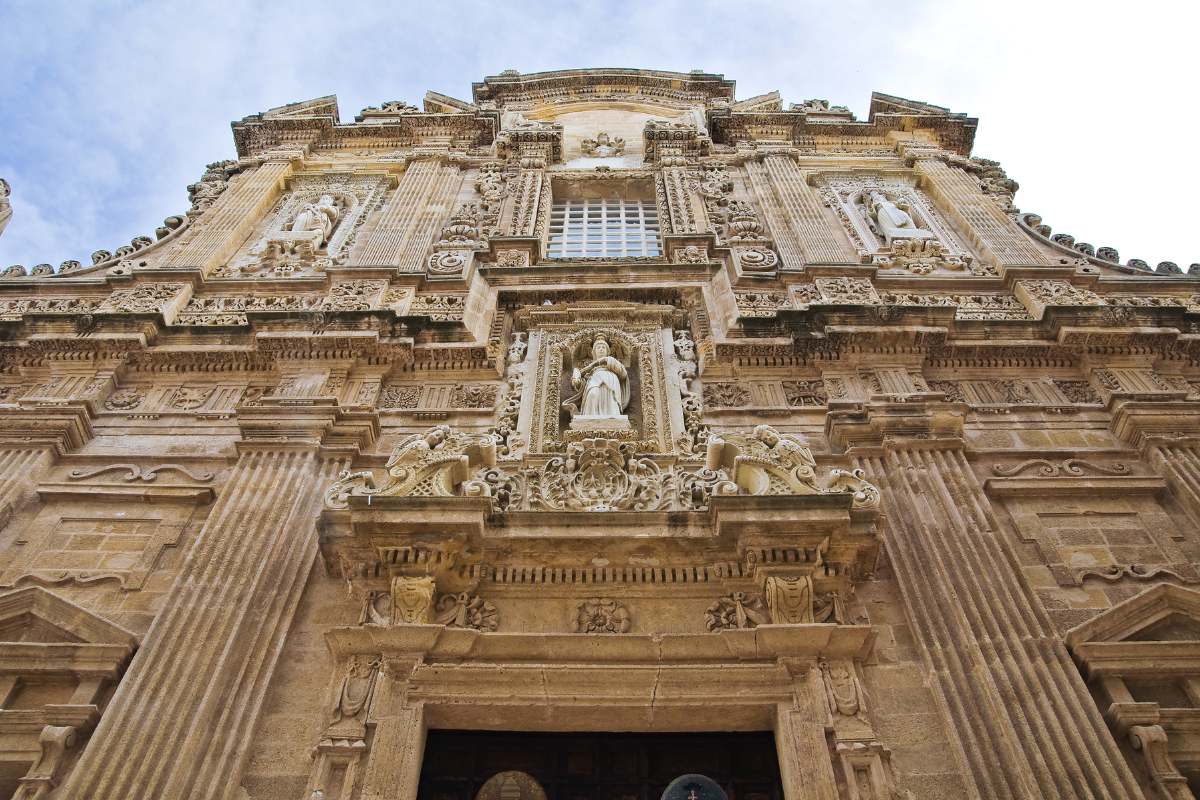
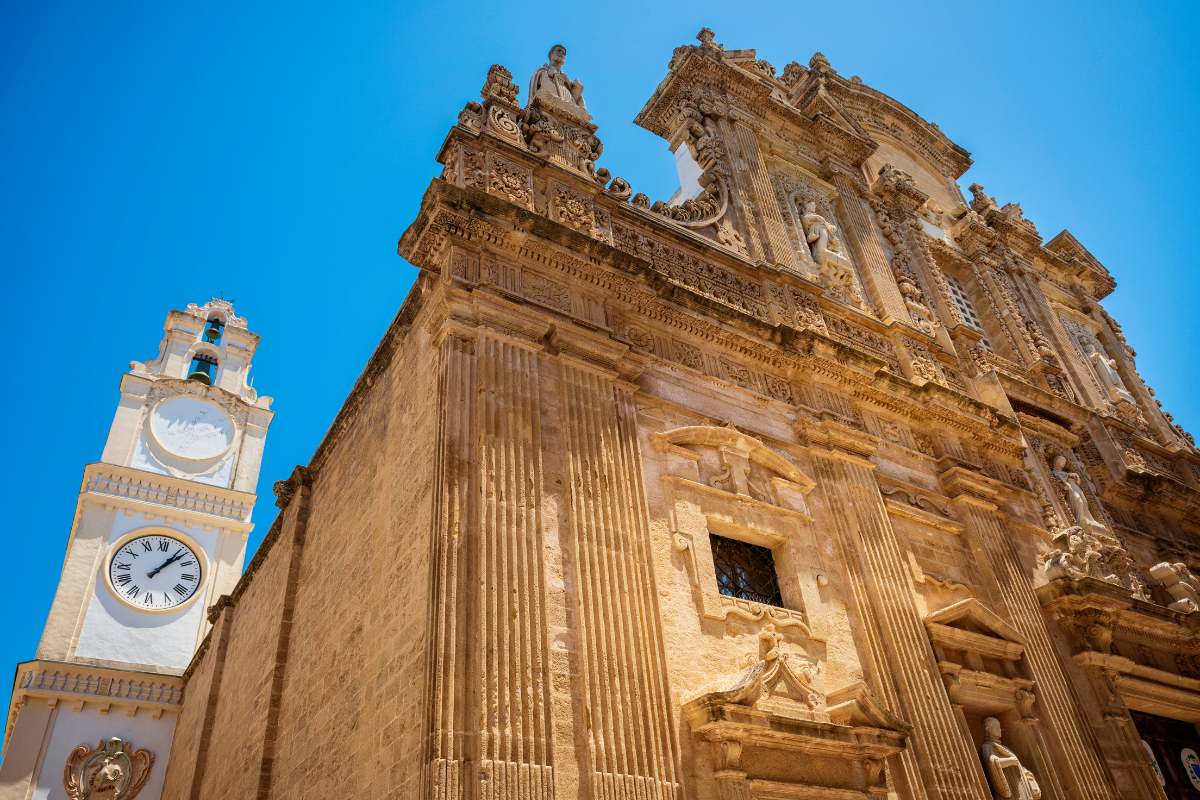
The main façade of the Basilica di Sant’Agata in Gallipoli is made of carp, a characteristic stone from Lecce, and stands out for its sumptuous decoration dating back to the period between 1600 and 1700. Imposing on the pediment is engraved the date of 1696, marking the completion of the construction of the cathedral. This exterior is a combination of two distinct architectural styles, developed between 1683 and 1696, with contributions from numerous architects. In 1683, the famous architect-sculptor, Giuseppe Zimbalo, influenced local artists in the decoration of the upper part of the facade.
Divided into two orders, the façade has a lower level characterized by Doric order pilaster, interspersed with entrance portals and niches that house the sculptures of Sant’Agata, San Fausto and San Sebastiano, all made in Lecce stone. The upper level follows the pattern of niches, here framed by frames, with statues of Santa Teresa d’Avila and Santa Marina. In the centre stands a large window, surmounted by a pediment that bears the date of 1696. Despite the absence of a bell tower, there is a civic tower which further enriches the architectural profile of the basilica.
Interior of the Basilica cattedrale di Sant’Agata
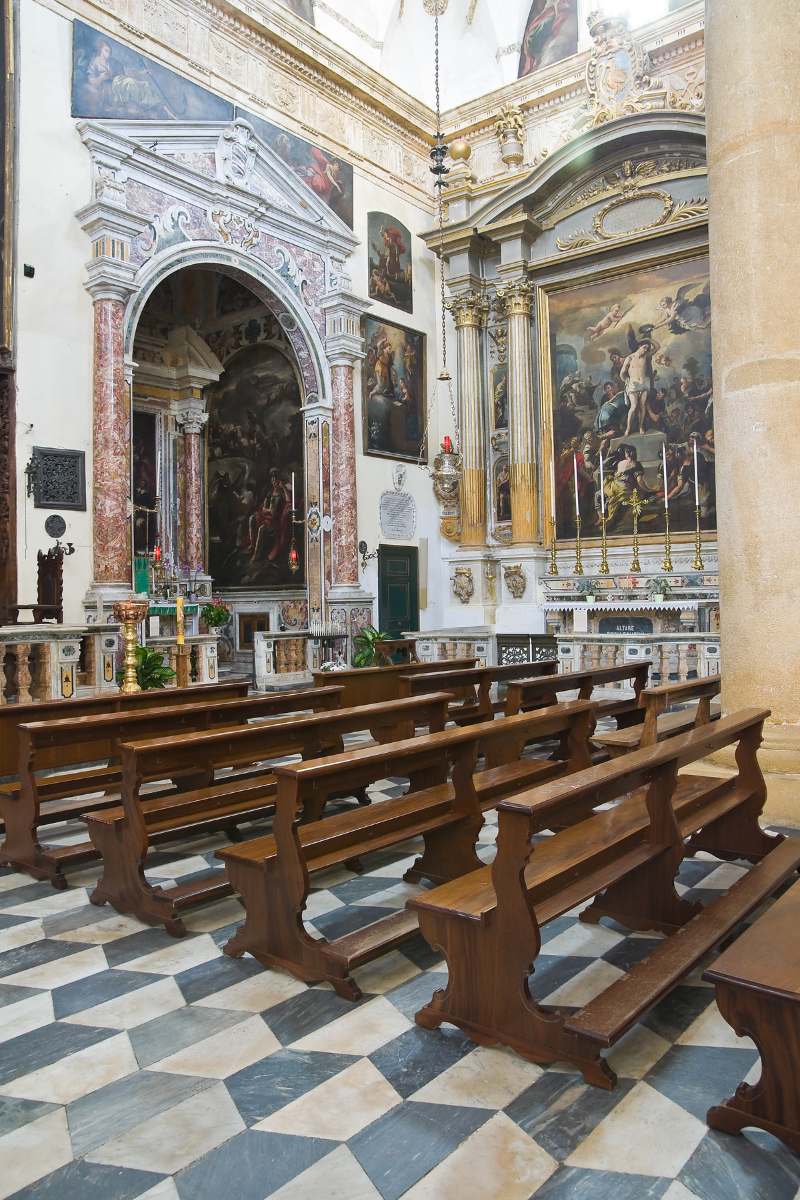
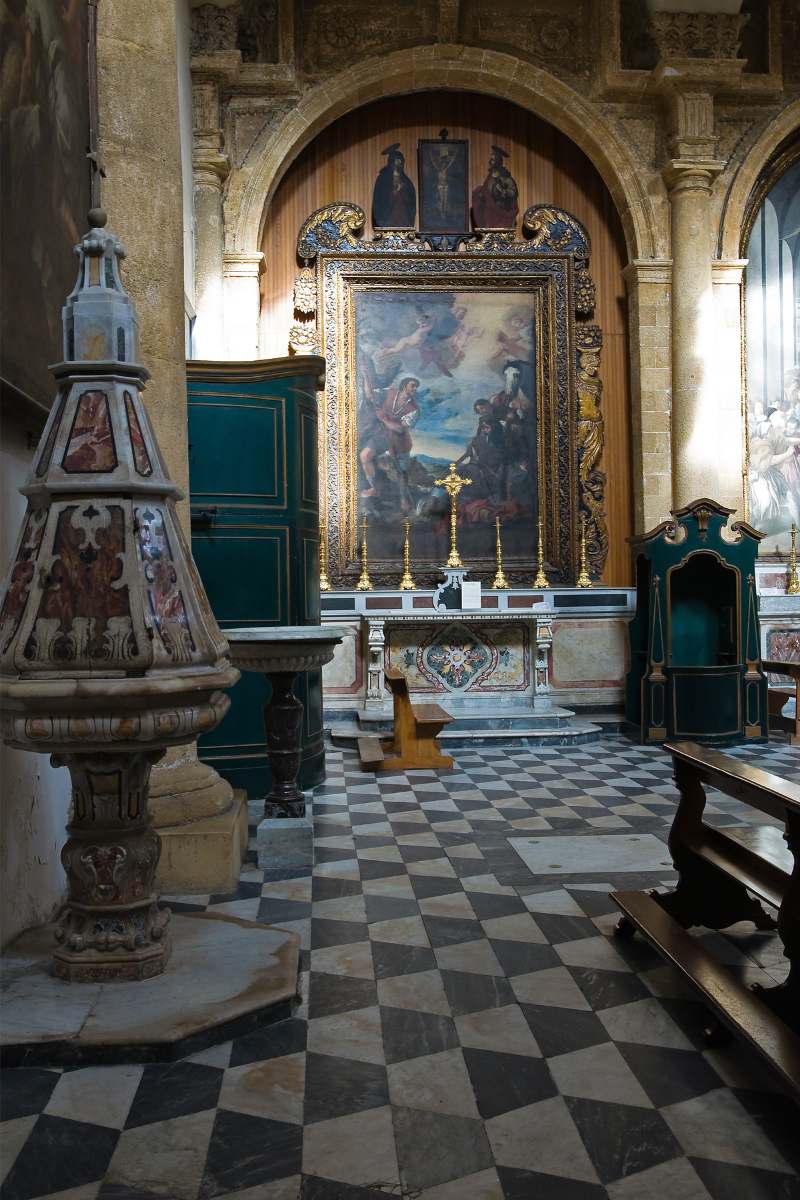
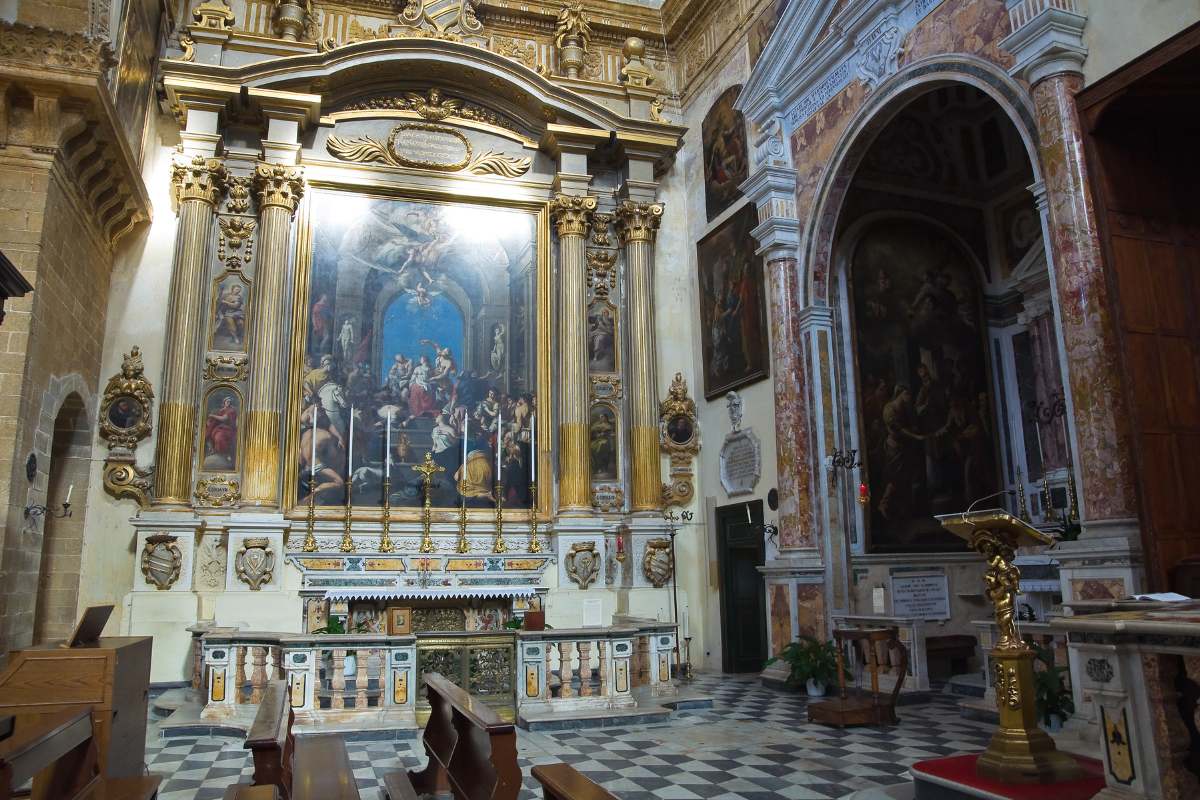
The Basilica cattedrale di Sant’Agata in Gallipoli, with its Latin cross structure and three aisles separated by twelve Doric columns, It exudes an atmosphere of refinement and rigor that blends harmoniously with the opulence of the surrounding frames and friezes. Inside the church, the twelve baroque altars add further solemnity. The high altar, by the German artist Giorgio Aver, is embellished with beautiful polychrome marbles that enhance its sumptuousness. Along the side aisles, painting takes on a predominant role, transforming the basilica into a veritable art gallery with paintings dating back to the 17th and 18th centuries.
The numerous altarpieces by local painters Giovanni Andrea Coppola and Giovan Domenico Catalano represent sacred scenes and decorate the altars dedicated to various religious figures. Among the most significant works, stands out the depiction of the Virgin with the Child between the Saints Andrew Apostle and John the Baptist, framed by eleven panels. Each altar holds a solemn altarpiece, offering the visitor a new artistic discovery at every step. In the 18th century, the Neapolitan painter Nicola Malinconico contributed unique paintings, scenes from the life of Sant’Agata and other religious episodes, further enriching the artistic heritage of the cathedral. His works include the Expulsion of Merchants from the Temple, the Entry into Jerusalem and the Miracle of the Paralytic, which add depth and meaning to the sacred context of the basilica.
The relics inside the Basilica of Saint Agatha
Inside the Basilica of Sant’Agata in Gallipoli are preserved precious relics of some saints, including Saint Fausto and Saint Agatha. Once, the breast of Sant’Agata was kept here until 1380, when it was transferred to the Basilica of Saint Catherine of Alexandria in Galatina. This move occurred at the end of the construction work on the building, promoted by its founder, Raimondello Orsini Del Balzo. The relic is linked to a miraculous event dating back to 1126, when a mother, guided by a premonitory dream, discovered her son with the breast of the saint in his mouth, giving testimony to its sacredness and thaumaturgical power.
Prices of Basilica cattedrale di Sant’Agata
You can visit the Basilica Cattedrale di Sant’Agata for free during opening hours.
Timetable Basilica cattedrale di Sant’Agata
The Basilica cattedrale di Sant’Agata is open every day from 09.00 to 12.30 and from 17.00 to 20.30.
Where is it and how to get there
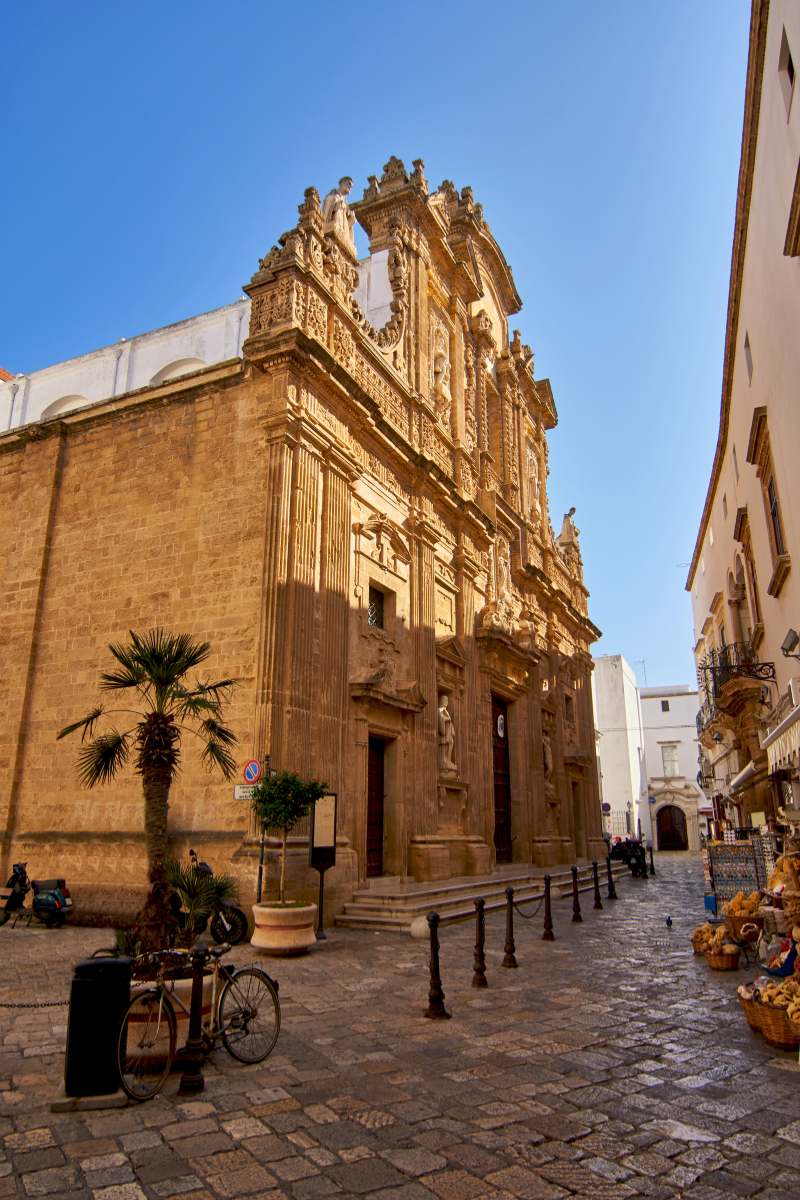
The Basilica of Sant’Agata stands majestically in the heart of the city of Gallipoli, in the Italian region of Salento, in Puglia. Located along the narrow streets of the old town, the basilica dominates the surrounding environment with its architectural grandeur and its rich religious history. Its central location makes it easily accessible, in fact you can reach it comfortably on foot.
To get to Gallipoli, you can use the train, the car and the bus.
- From Lecce you can take a regional train FSE to Gallipoli.
- From Lecce you can also use the Salento bus lines that are active in summer.
- Finally, if you want to reach Gallipoli by car, you can take the SS101 from Lecce and continue for about 40 km.